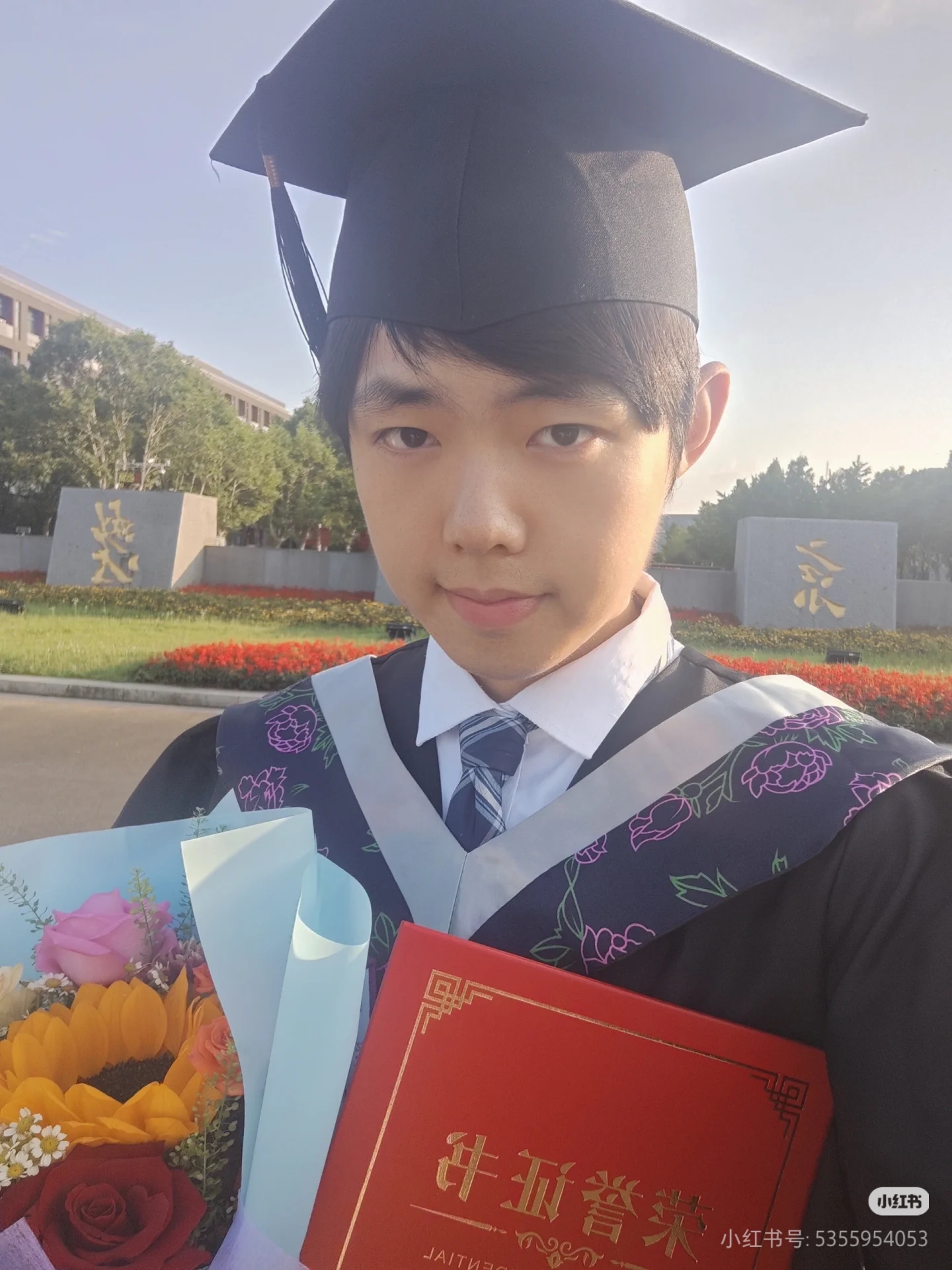
I was born in a small city in East Asia, Qufu–quiet, a little behind the times, yet carrying an old and enduring gravitas. It is best known as the hometown of Confucius, often called the “Aristotle of the East.” Growing up there shaped me in more ways than I understood at the time: it gave me a deep cultural grounding and taught me humility, courtesy, and a certain steadiness of mind. I remain profoundly grateful for that inheritance. And yet, precisely because it was so small, opportunities to encounter cutting-edge education and a wider intellectual horizon were rare.
Above all, I owe my earliest awakening to my father. He loved both the natural sciences and the humanities. When I was still very young, he would take me to the library and borrow books far beyond what a child was “supposed” to read–stories of the Hubble Space Telescope and Edison, alongside Western history and Chinese philosophy. Immersed in these treasures of human thought, I formed an early conviction: I wanted to become a scientist. The reason was simple, almost naive in its clarity–because I believed a scientist could contribute to humanity’s lasting happiness and well-being, in a way that endures longer than any single profession. Once I made that choice, I resolved–without compromise–to live by it.
In my secondary-school years, I was moved to tears three times by the power of the human spirit–twice through literature and philosophy. But the deepest impact came from science. I began reading university-level introductory physics ahead of schedule, and one day I understood something that felt like a secret door opening: how the low-velocity laws of Newtonian mechanics emerge naturally as an approximation of special relativity. The familiar rules governing our everyday world no longer seemed arbitrary or “given from the sky”; they had a principled origin. The exhilaration of seeing that bridge–of watching one framework contain another–was overwhelming. From that point on, every subsequent encounter with physics felt less like “learning a subject” and more like recognizing myself.
When I entered university, I chose one of China’s top institutions–renowned for a long tradition in physics and once considered among the very best in the country. But I had grown up with a limited view of how the field had evolved. Only after arriving did I realize that, amid intense competition, the discipline had declined in relative strength–and more painfully, that there was no faculty member working in the direction I most needed: formal theoretical physics and the foundations of the subject. On my third day, I spent the entire night–until five in the morning–reading the webpages of every professor in the department, searching for a home for my questions. I found none, and the disappointment was sharp.
Yet my resolve did not waver. Over the next three years, I carried my books and crossed thresholds–studying wherever I could, at neighboring universities and beyond, because I had no local mentors or peers with whom to exchange ideas. In this, I was saved by the internet: through it, I learned from teachers and students of theoretical physics around the world. Their generosity–especially their willingness to spend time with a young stranger driven by questions–changed the trajectory of my life. I must also mention one senior student who influenced me profoundly; he is now a postdoctoral fellow at MIT, and in the earliest stage of my journey he was, in a real sense, my first mentor. He transmitted to me his boundless love for theoretical physics, a kind of heat that has never left me.
The cost of lacking formal guidance, however, was also real. I taught myself through an enormous volume of advanced textbooks, and I sought out conferences and reading groups wherever possible. Over time, my grasp of frontier ideas–and the technical foundation beneath them–often surprised my peers.
During the application season at the end of my undergraduate studies, I applied to only one world-leading institution–yes, only one. It sounds difficult to understand, but my reasoning was stark: if I had truly become the person I aspired to be, I would be admitted; if not, then I was not yet ready, and I needed further tempering. No matter the cost, I was willing to keep refining myself until I could honestly call myself a qualified PhD candidate in theoretical physics. Such a mindset is uncommon among my contemporaries–especially in East Asia, where discipline and prescribed paths are emphasized, and young people are expected to “finish quickly” and move on to work, rather than to be asked what their inner development truly requires.
Along this path, I also began to understand my own difference. I can sustain an almost continuous intensity; I throw my whole mind and spirit into fundamental science with little appetite for rest or entertainment. And yet, in formal classroom settings, I found listening and following lectures unexpectedly difficult. Later, I learned that this pattern had a name–attention-deficit/hyperactivity disorder (ADHD). It helped explain why my performance could be strong while my transcript did not always reflect my real capabilities. In addition, higher education in China tends to reward exam-oriented problem solving more than creative exploration. During my exchange at Berkeley, I earned perfect scores in advanced courses–while in the domestic system I repeatedly fell short of what my understanding would suggest.
By now, a reader might wonder: if my interests are so broad, what holds them together? I have worked in astronomy and quantum gravity, and in a project on quantum gravity and cosmology I served as a co-first author, taking primary responsibility for the quantum-gravity side–from the initial idea to theoretical validation. The work received substantial attention in the wake of the DESI DR2 release. Yet at my core, I remain a deeply committed theorist of fundamentals. My current questions span quantum gravity, quantum many-body physics, and symmetry–touching quantum cosmology, quantum information, and AI for science; mixed states and strong-to-weak symmetry breaking, non-invertible symmetries, and black holes. Some of these problems are intensely personal–ideas I have carried for years; others are collaborations with researchers and peers across Europe, China, and North America, including colleagues connected to Perimeter, with results expected to appear in 2026.
To further temper my foundations, expand my horizon, and refine my judgment, I pursued a summer exchange at Berkeley and a summer visit to Santa Barbara. These experiences were invaluable. I not only received world-class training, but also had the privilege of extended conversations with leading theorists–Geoff Penington, Raphael Bousso, and Peter Horava among them–learning both from their lectures and from the way they think. Over roughly half a year, I also visited Princeton, Santa Barbara, Harvard, MIT, and Stony Brook, exchanging ideas with students and researchers and dramatically widening my view of what theoretical physics can be. These travels placed a heavy financial burden on my family, but to me they were worth it. I want to express my deepest gratitude to my parents–especially my father and mother–for supporting my path when it demanded real sacrifice.
A final question naturally follows: how have I found the time and energy to study so many themes? The answer is not mysterious. I have traded away nearly all leisure and travel, and often even sleep. More than once I have slept sitting upright in an office chair or with my head on a desk, without ever lying down. I believe that willpower–plain, stubborn, sustained–matters: it is one of the few tools that can carry a person through prolonged difficulty. With that stubbornness, in my second year I spent a single month teaching myself the foundations of quantum field theory, and then continued onward into deeper topics.
In closing, regardless of the outcome of the PSI Start competition, I offer my sincere wishes: may the Institute flourish for a long time, and may those selected receive rich and beautiful training under the guidance of outstanding mentors–and step toward an even brighter future.